In the world of PC and console gaming, the conversation is almost always dominated by specifications. We obsess over frame rates, refresh rates, ray tracing capabilities, and pixel density. We debate the merits of OLED versus QLED and spend hours tweaking settings to squeeze out an extra five frames per second.
However, in this race for technical perfection, many gamers have overlooked the single most impactful factor in gaming immersion: sheer scale.
While a 27-inch monitor offering 240Hz is ideal for a competitive e-sports athlete sitting at a desk, it fails to capture the cinematic grandeur intended by the developers of open-world RPGs or narrative-driven action games. For the console gamer looking to be transported into another world, the next frontier isn’t 8K resolution—it is the 120-inch display.
The Field of View Factor
The primary argument for “going big” is biological. Immersion is largely a function of how much of your field of view (FOV) is occupied by the game world. When you play on a 65-inch television from ten feet away, your peripheral vision is filled with your living room—the coffee table, the window, the cat sleeping on the rug. Your brain never fully suspends disbelief because it is constantly reminded of your real-world surroundings.
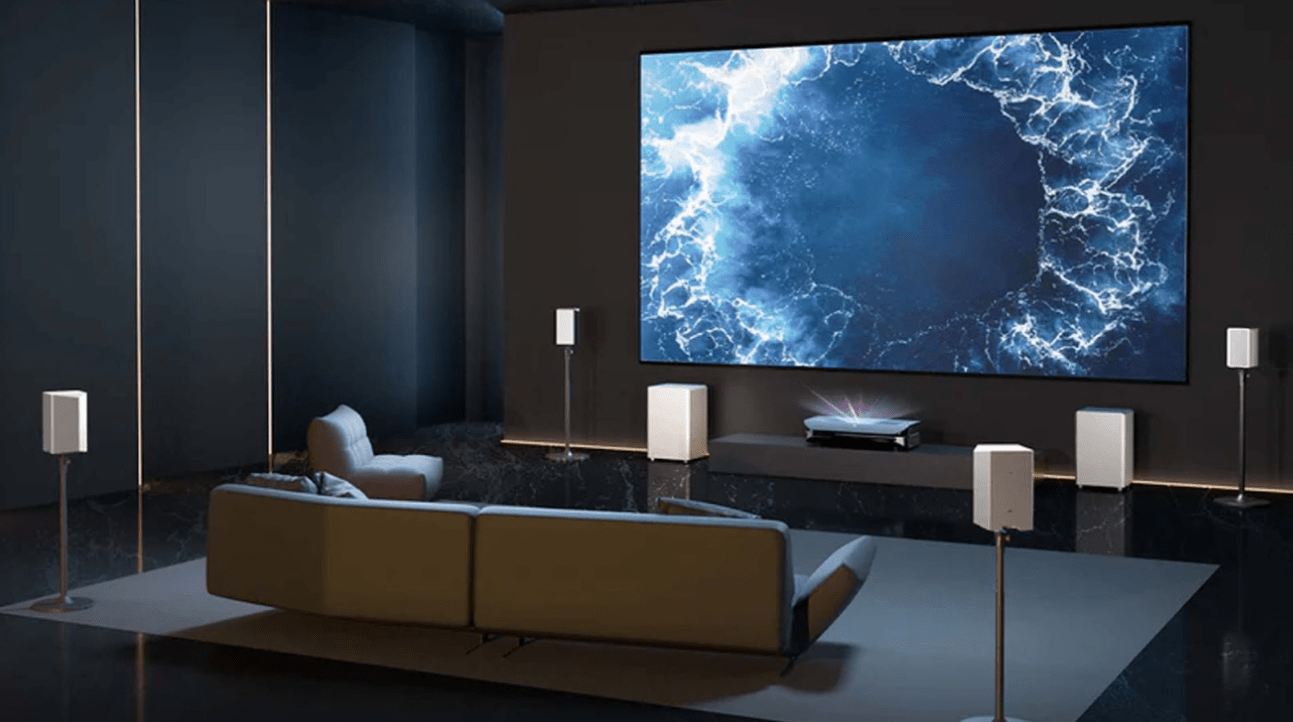
When you step up to a 100, 120, or even 150-inch image, the game world expands to fill your peripheral vision. This creates a sense of presence that a standard television simply cannot replicate. In a racing simulator, you feel the speed in the corners of your eyes. In a first-person shooter, the enemies are life-sized. This isn’t just a bigger picture; it is a fundamental shift from “watching” a game to “being inside” it.
Busting the Latency Myth
Historically, projectors were terrible for gaming. They were plagued by high input lag (the delay between pressing a button on the controller and seeing the action on screen) and motion blur. For a long time, “serious” gamers wouldn’t touch them.
That narrative is outdated. The latest generation of laser projectors, particularly Ultra Short Throw (UST) models, has been engineered with gaming in mind. Many modern units now feature dedicated “Game Modes” that bypass unnecessary image processing to drop input lag to sub-15ms or even sub-8ms levels, rivaling many standard televisions.
Furthermore, with support for 4K at 60Hz and 1080p at 120Hz, these projectors can handle the output of the PS5 and Xbox Series X without breaking a sweat. The motion handling on laser units is also exceptionally smooth, maintaining clarity during fast-pan camera movements that often cause judder on cheaper LCD panels.
The Revival of Split-Screen Multiplayer
One of the casualties of the modern gaming era has been local couch co-op. As games became more complex and UI elements became more detailed, splitting a TV screen into two, three, or four quadrants made the game unplayable. On a 55-inch TV, a four-player split-screen gives each player a tiny, phone-sized window. It’s impossible to read the mini-map or manage inventory.
A 120-inch projection setup resurrects the glory days of local multiplayer. When you split a 120-inch screen into four, every player gets the equivalent of a 60-inch television. This makes games like Mario Kart, Halo, or Borderlands genuinely enjoyable for a group again. It transforms a gaming session into a massive social event, something that lonely online matchmaking simply cannot replace.
The Critical Role of the Surface
Transitioning to a projection setup for gaming does require one specific consideration that TV users ignore: the surface. In a dedicated dark room (a “bat cave”), a white wall might suffice, but most gamers play in living rooms with windows or ambient lighting.
To maintain contrast levels that allow you to spot enemies in dark corners or appreciate the vibrancy of a fantasy world, you cannot project onto a standard textured wall. Pairing the laser unit with a specialized projector screen is essential. For gaming, you specifically want an Ambient Light Rejecting (ALR) screen. These screens ensure that the blacks remain deep and inky rather than washing out to grey, preserving the dynamic range that modern game engines work so hard to render. Additionally, a fixed-frame screen provides a perfectly flat, tensioned surface, ensuring that the geometry of the HUD (Heads-Up Display) and crosshairs remain perfectly straight and distortion-free.
Cost Per Inch: The Economic Argument
Finally, there is the math. As televisions get larger, their price increases exponentially. A high-quality 85-inch TV is expensive; a 98-inch TV is astronomically priced, often costing as much as a small car. Beyond 100 inches, traditional panels are virtually non-existent for the average consumer.
Projectors offer a linear value proposition. A high-end laser projector and screen combination can deliver a 120-inch or 150-inch image for a fraction of the cost of a comparably sized panel (if one even existed). For gamers who measure value in terms of “immersion per dollar,” projection is the undisputed leader.
Conclusion
We are in a golden age of video game graphics. Artists and developers are creating worlds of breathtaking detail and scope. Viewing these masterpieces on a confined rectangle across the room does them a disservice.
If you are looking to upgrade your battle station or media room, look beyond the standard black rectangles. When you shop movie projectors today, you aren’t just looking for film equipment; you are looking for the ultimate gaming peripheral. The jump to 120 inches changes the way games feel, turning a passive hobby into an all-encompassing experience.